
5 Key Moments in the History of Rock ‘n’ Roll
- THE BEATLES
It’s hard to say precisely when rock ’n’ roll began, though the genre has its roots in African American music such as jazz, rhythm and blues, boogie-woogie, and gospel, as well as country music. Ask a room full of music historians what the first rock ’n’ roll record was and you’ll likely receive a number of different answers. Was it Sister Rosetta Tharpe’s “Strange Things Happening Every Day” in 1944? Or perhaps “Rocket 88,” first recorded in Memphis by Jackie Brenston & His Delta Cats in 1951? Or Bill Haley & His Comets’ 1955 single “Rock Around the Clock?” It’s hard to say for sure.
Advertisement
What we do know is that rock ’n’ roll became a defined mainstream genre during the 1950s, when the sound and the image coalesced around one man: Elvis Presley. Elvis took rock music to new and giddy heights, bringing about a seismic shift in popular culture — and causing deep concern among certain sections of society that considered rock the “devil’s music.” Once unleashed, however, there was no going back: Rock ’n’ roll was here to stay. Here are some of the most defining moments in the history of the genre, from the King himself to the rise of MTV.

Elvis on Ed Sullivan
On September 9, 1956, Elvis Presley made his first appearance on The Ed Sullivan Show. At this point, Elvis had already put out a number of successful singles, and his debut album, Elvis Presley, released in March 1956, was the first rock ’n’ roll album to make it to the top of the charts. Elvis had yet to cement his status as the “King of Rock ’n’ Roll,” but his first performance on Ed Sullivan can be seen as his coronation. He performed a number of songs — including “Don’t Be Cruel,” “Hound Dog,” and “Love Me Tender” — in front of screaming audience members at the studio and watching from home. Despite ongoing fears that his hip-shaking gyrations would corrupt the nation’s youth, viewers were given full head-to-toe shots of the 21-year-old singer’s performance. The show was a massive success, as 60 million people — 82.6% of the entire television audience at the time — tuned in to watch the then-21-year-old perform.
You may also like
- Revealing Facts About 5 Celebrated Painters
- 5 Facts About England’s Elizabethan Era
- Unforgettable Moments in Baseball History
Advertisement
Advertisement
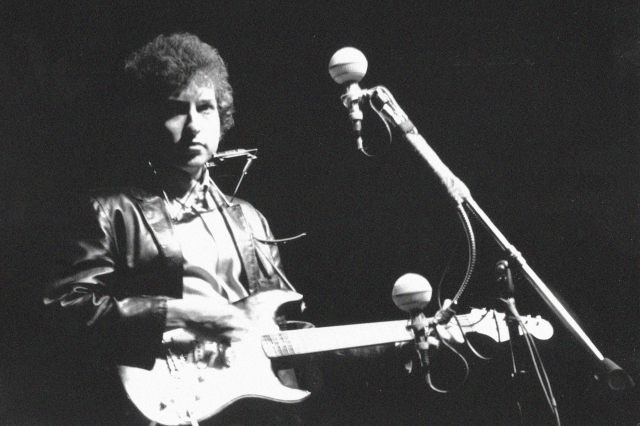
Dylan Goes Electric
Rock historians aren’t in total agreement as to what precisely went down when Bob Dylan took the stage at the Newport Folk Festival on July 25, 1965. They all agree, however, that it was a hugely significant night for rock music. Dylan was the champion of the folk music revival of the early 1960s — a traditionally all-acoustic movement. So, when he strode onto the stage carrying a Fender Stratocaster rather than his more familiar acoustic guitar, the crowd was not pleased.
At the time, Dylan’s now-classic single “Like a Rolling Stone” was hugely popular on the radio, but folk purists didn’t like the song’s mix of electric blues and rock ’n’ roll. When Dylan and his accompanying backing band — some also wielding electronic instruments — started playing, sections of the crowd began booing. Accounts vary as to the intensity of the crowd’s reaction, but Dylan played only three songs before leaving the stage. When he returned, he performed two songs on acoustic guitar — “Mr. Tambourine Man,” followed by “It’s All Over Now, Baby Blue” — and then left for good. It was an edgy night by most accounts, but a pivotal moment in the development of folk rock, expanding the bounds of rock ’n’ roll.
Advertisement
Advertisement

The Beatles Release “Sgt. Pepper’s Lonely Hearts Club Band”
In 1967, Paul McCartney played the Beatles’ latest album, “Sgt. Pepper’s Lonely Hearts Club Band,” to Bob Dylan. Dylan’s response: “Oh, I get it, you don’t want to be cute anymore.” He was right — the Fab Four had turned a creative corner. Deciding that live performances and screaming fans weren’t enough, they wanted to become a serious studio band, and with “Sgt. Pepper’s,” the Beatles announced to the world that they were true artists. The album was revolutionary. Regarded by many as the first concept album, it is bursting with creativity and musical innovation, featuring French horns, tape loops, bass harmonicas, harpsichords, sitars, and more. The album changed not only rock music, but pop culture itself.
Advertisement
Related:Revealing Facts About 5 Celebrated Painters
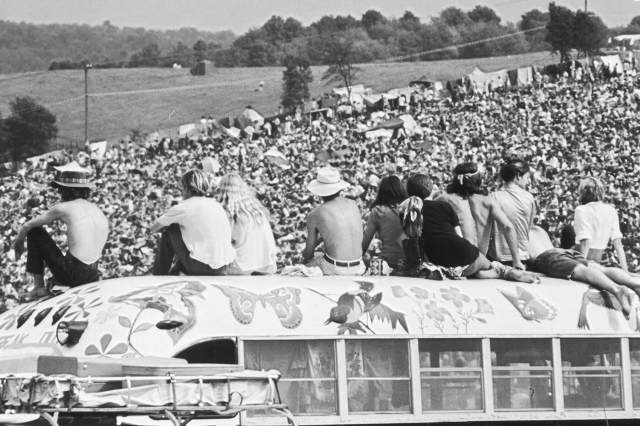
Woodstock
On August 15, 1969, 32 acts and more than 400,000 attendees arrived at Max Yasgur’s dairy farm in Bethel, New York, for three days of peace, love, drugs, and, most importantly, rock ’n’ roll. It was immediately obvious that the festival was going to be big, but no one knew just how iconic Woodstock would become. Despite various technical difficulties, food shortages, and bad weather, the festival became a living embodiment of the 1960s counterculture. As for the lineup, it was quite something: The Who, Carlos Santana, Jefferson Airplane, Janis Joplin, Sly and the Family Stone, the Grateful Dead, The Band, Creedence Clearwater Revival, Joan Baez, and Crosby, Stills, Nash & Young, to name but a few. And then there was Jimi Hendrix, who gave arguably the most iconic performance of the entire festival with his stirring, feedback-fueled rendition of “The Star-Spangled Banner.”
Advertisement
Advertisement
The Launch of MTV
Just after midnight on August 1, 1981, MTV — the world’s first television channel devoted to showing music videos — launched with the announcement, “Ladies and gentlemen, rock and roll,” as the station went on air. The first video broadcast on the fledgling channel was, fittingly, “Video Killed the Radio Star” by the Buggles. Despite some initial hype and interest, MTV struggled in its early years, in part due to a lack of music videos. But as it expanded its programming, MTV took off in a major way. By the mid-1980s, it was having a major cultural impact not only on music and TV but also on movies and advertising. Record companies began noting video’s effect on record sales, and soon the channel was launching the careers of newcomers such as Prince, Cyndi Lauper, and Duran Duran, and turning the likes of Madonna and Michael Jackson into global superstars. Music videos became big business, and MTV’s adoption of grunge and rap in the 1990s brought about a major shift in popular music
Recent Comments