
Curatorial Corner – Shared History, Shared Stewardship
One of the most rewarding aspects of creating the Jon Landau American Music Gallery has been the opportunity to work with collectors, archives, museums, artists, and organizations from across the country. While visitors see a seamless story unfolding across the gallery, many of the objects on display have traveled remarkable journeys before arriving at the Bruce Springsteen Center for American Music.
The Jon Landau American Music Gallery explores the rich and complex history of American music, tracing its evolution from Indigenous traditions and spirituals to gospel, blues, jazz, country, rock & roll, hip-hop, and beyond. Along the way, visitors encounter iconic objects connected to some of the most influential artists and cultural movements in American history. Many of these items come from peer institutions and collectors who share our commitment to preserving and interpreting America’s musical heritage. Some of these amazing partners are hyperlocal, others are global icons—like Hard Rock International.
For decades, Hard Rock has assembled and cared for one of the world’s largest collections of music memorabilia. Their holdings include instruments, stage costumes, handwritten lyrics, awards, photographs, and countless other artifacts that help tell the story of popular music. There is an abundance of objects featured in our galleries on loan through Hard Rock, allowing our visitors to engage directly with pieces of history that might otherwise remain out of reach.
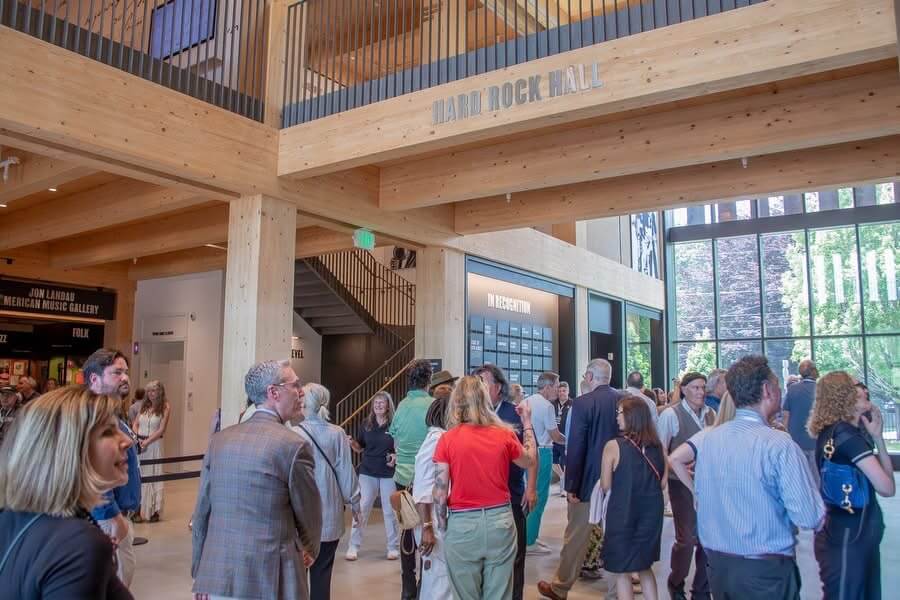
Guests gather in Hard Rock Hall, before venturing into our Jon Landau American Music Gallery. You’ll have to visit us to see the artifact therein!
As our Center begins its next chapter, we are grateful for partnerships like this one. Preserving music history is not the work of any single institution. It requires collaboration among collectors, museums, archives, artists, and communities who recognize the importance of safeguarding these stories for future generations.
Recently, I had the opportunity to speak with Giovanni Taliaferro, Vice President of Memorabilia and Design for Hard Rock, about the origins of their collection, the challenges of preserving music memorabilia, and the value of partnerships that help bring these remarkable objects to new audiences. Here’s what he had to share:
How did Hard Rock’s memorabilia collection begin, and did anyone imagine it would grow into one of the largest music collections in the world?
Hard Rock’s collection began the way a lot of great stories do—organically, with a love for music and a bit of attitude. The very first Hard Rock Cafe opened in London in 1971, given only a six-month lease by the landlords, and at that time there was no memorabilia on the walls. The original vision was simple: an Americana-style diner where everyone was welcome and treated the same, regardless of status—“Love All, Serve All,” a philosophy that’s been part of our DNA from the very beginning.
The interiors were eclectic—American sports pennants, vintage signage, and playful tin cars and planes suspended—but music was always present in the atmosphere. The cafe on Old Park Lane quickly became a gathering place for both fans and some of the biggest artists in the world, even hosting intimate performances like Paul McCartney debuting Wings in 1973.
Then in 1979, Eric Clapton asked to hang his guitar to mark his favorite seat. Shortly after, Pete Townshend sent one of his guitars with the note, “Mine’s as good as his.” That moment sparked what would become our global collection.
At the time, no one was thinking about building an archive of global significance. But that spirit—artists connecting with fans through tangible pieces of their story—is still at the core of what we do today. What began as a single moment has grown into a collection that spans generations, genres, and cultures.
What were some of the earliest acquisitions, and why were they significant?
Those early pieces were significant not just because of who they came from, but because of what they represented. They established the foundation of the collection, which is now close to 90,000 pieces strong.
At what point did Hard Rock realize it wasn’t simply collecting souvenirs, but preserving cultural history?
That shift happened pretty quickly as the collection began to reflect something larger than any single artist or moment. A key moment was the opening of the New York City Hard Rock Cafe on 57th Street in 1984, followed by significant acquisitions during a Sotheby’s auction in 1986, which elevated both the depth and visibility of the collection, becoming synonymous with the brand’s identity.
What makes an artifact worthy of inclusion in the Hard Rock collection?
It always comes back to three things: authenticity, story, and impact. Authenticity is paramount. We don’t pursue acquisitions where the only provenance is “photo-matched.” That’s something we’re seeing more of across the industry, and it’s a clear red flag for us. Our team conducts extensive due diligence on every piece, and if it doesn’t have strong, credible provenance, it’s simply not considered.
Beyond authenticity, we focus on storytelling—both the story of the piece itself and the artist behind it. What’s especially important is how those stories are brought to life across our global portfolio. Every Hard Rock property is curated with intention, and no two collections are the same. Each location reflects a balance of globally recognized artists alongside the music culture of that specific market.
Our collections are designed to be as much about today’s artists as they are about those who came before. Whether highlighting voices like Lady Gaga, Bruno Mars, and Sabrina Carpenter or showcasing emerging local talent, we aim to reflect the evolving sound of each market while honoring the legacy that shaped it.
Ultimately, we look for pieces that represent something larger—whether it be a defining moment, a creative breakthrough, or a cultural shift. These aren’t decorations to us; they’re our Mona Lisas.
What are some of the biggest challenges involved in preserving music memorabilia?
The biggest challenge is balancing preservation with accessibility. These items were never meant to sit behind glass — they were created to be used, worn, and experienced.
At the same time, they’re often extremely fragile. Light, temperature, and time all play a role in deterioration. That’s why we’ve developed strict preservation standards across all our properties—to ensure we can share these pieces with guests while protecting them for future generations.
Hard Rock often displays artifacts in hotels, cafes, and entertainment venues rather than traditional museums. How does that shape the visitor experience?
It makes the experience more immediate and personal. Guests aren’t stepping into a formal museum environment; they’re encountering music history in places where they’re already engaged and open.
That approach reflects who we are as a brand. We bring music and entertainment to the forefront of everyday experiences, and that allows guests to discover these stories in a way that feels natural, not curated at a distance. Anyone can design a beautiful space; the memorabilia and the stories we share are true differentiators.
What do you hope a young visitor takes away after seeing a piece of music history in person?
I hope they see possibilities. Behind every piece of memorabilia on display is someone who took a chance, found their voice, and created something that resonated with the world. If a young visitor walks away inspired to learn more, express themselves, or pursue something creative, then that connection has done its job.
Have you seen particular artifacts spark especially powerful reactions from visitors?
All the time—even from our own team. Music is deeply personal, and everyone carries their own soundtrack through life.
There are moments when a guest encounters a piece tied to a memory—such as a first concert, a milestone, or a moment of joy or loss—and it becomes incredibly real, bringing that individual back to that time and period. That emotional connection is what makes these pieces so powerful.
On a personal level, I’ve experienced that myself. Growing up, my mother would play “Imagine” by John Lennon on the record player in her bedroom while doing chores, and it’s one of my earliest memories. She would put me on the bed while that album was playing. After she passed away and my family was going through her possessions, I found that record and the floodgates immediately opened. Then later, seeing John Lennon’s handwritten lyrics to “Imagine” in our collection, it was a full-circle moment. I was instantly transported back to being on that bed. That’s the kind of personal connection these pieces can create.
Are there genres, artists, or communities whose stories deserve greater representation in collections?
Absolutely. Music is constantly evolving, and our collection has to evolve with it.
There are countless voices across genres, cultures, and communities that have shaped and continue to shape music in meaningful ways. Expanding that representation isn’t just important; it’s essential to truly reflect the global impact of music today.
How can collecting help preserve not just artists, but broader cultural movements?
Memorabilia serves as an entry point. A single piece can open the door to a much larger story about a moment in time, a cultural shift, or a movement that changed how people think and express themselves.
By preserving these objects and providing the right context, we’re helping ensure those stories endure.
Looking ahead fifty years, what do you hope people will say about the role Hard Rock played in preserving the history of American music?
I hope they see that we understood early on that music is much more than entertainment—it’s culture, identity, and history.
And that we take that responsibility seriously, not just by collecting pieces of memorabilia, but preserving stories, amplifying voices, and making those experiences accessible to people all over the world.
If we’ve done it right, the collection won’t just reflect the artists of yesterday and today; it will continue to inspire the future.
Thanks to Gio for sharing these stories with us, and to Hard Rock International for being so collaborative and collegial.
Melissa Kozlowski
Director of Curatorial Affairs
Bruce Springsteen Center for American Music
Monmouth University
June 23, 2026
Facebook Instagram X-twitter Youtube Linkedin
382 Cedar Ave, Long Branch, NJ 07740
Recent Comments